

If you plan to move to Spain for study, remote work or retirement, start with the rules that apply to your stay. 🇪🇸 Then plan the paperwork you may need after you arrive.
Use this moving to Spain checklist to plan your visa, local documents, housing and health cover. Check each step against your own situation.
👉 Check what cover your consulate asks for → Explore insurance plans

1️⃣ Get your visa sorted first
First, check the visa or permit you need with your Spanish consulate. If you need approval, wait for it before you make firm travel plans. These are three routes to check:
- Student Visa (for eligible study or training).
- Digital Nomad Visa (for remote work or freelancing).
- Non-Lucrative Visa (for retirees or those not working).
Your consulate lists the documents for each route.
✅ Check the financial means rules if you plan to study.
✅ Ask whether you need proof of where you will stay.
✅ Check if the consulate asks for health cover with no copays.
If your route requires health cover, check the policy against the consulate’s list before you pay.
👉 Review the policy details for your route → Get a quote
2️⃣ Health insurance: what the consulate expects
First, check whether health cover is part of your own visa requirements. For example, the telework route may accept proof of Spanish public coverage.
If you need a policy, ask the consulate about these points:
- Where the policy must cover you.
- What care the policy must cover.
- Whether it must have no copayments or deductibles.
- Whether it must be paid upfront and for how long.
- Which language your certificate must use.
Then ask the insurer to confirm the terms in writing. The consulate decides whether the proof meets its rules.
👉 Check your route’s health cover rules → Compare plans

3️⃣ Obtain your NIE (Número de Identidad de Extranjero)
A NIE is a number that identifies you in dealings with Spanish authorities. First, check whether your permit process already assigns one. A bank or landlord may also ask for it.
If you need to request a NIE separately:
- Book an appointment (cita previa) at your local immigration office or police station.
- Check which identity documents and forms to bring, including EX-15 if you apply for a NIE.
- Pay the small fee (Modelo 790).
Once you have the number, keep a copy for reference.
4️⃣ Register your address: the Padrón
The padrón is the town hall’s register of residents. It records your usual address. To sign up, check what proof your town hall accepts.
To register:
- Visit your local ayuntamiento (town hall).
- Check which proof of identity and address the town hall accepts.
- You’ll receive a printed certificate (volante de empadronamiento).
Keep the record of your address for services that ask for it.
5️⃣ Apply for your TIE (Tarjeta de Identidad de Extranjero)
A TIE is a card that shows your status in Spain. For example, if you have study permission for more than six months, apply within a month of arrival when that is how your permit starts. Check the deadline in your case.
Steps:
- Book your cita previa online.
- Check the list for your type of TIE. It may ask for a passport, photo, proof of payment or an address record.
- Attend your appointment and give fingerprints.
- Ask when and where to collect the card.
Check the expiry date on your TIE. If you extend your permit, ask when you need to apply for a new card.

6️⃣ Set up your finances
To manage your life in Spain smoothly:
- Open a Spanish bank account (some banks allow non-residents).
- Set up direct deposits for rent and utilities.
- Keep proof of financial solvency for visa renewals.
Having local banking also simplifies health insurance payments and renewals.
7️⃣ Find housing and sign your rental contract
Check which documents you need before you sign a lease. If your visa route asks for proof of housing, ask the consulate what it accepts.
Tips:
🏠 Book short-term accommodation first (Airbnb or student residence).
📑 Once in Spain, look for a long-term rental with a formal contract (contrato de arrendamiento).
🪪 Always use your NIE and passport for official paperwork.
8️⃣ Learn some Spanish basics
Basic Spanish can help with errands and appointments. For example, learn how to ask for a document at the bank or explain what you need at a shop.
9️⃣ Join the healthcare system (if eligible later)
If you are not eligible for public cover through another route, ask your region about the Convenio Especial.
There are residence and other conditions. Check which cover applies to your case:
- Whether you already have public cover through another route.
- What the regional agreement covers.
- Whether your permit renewal still needs separate proof of cover.
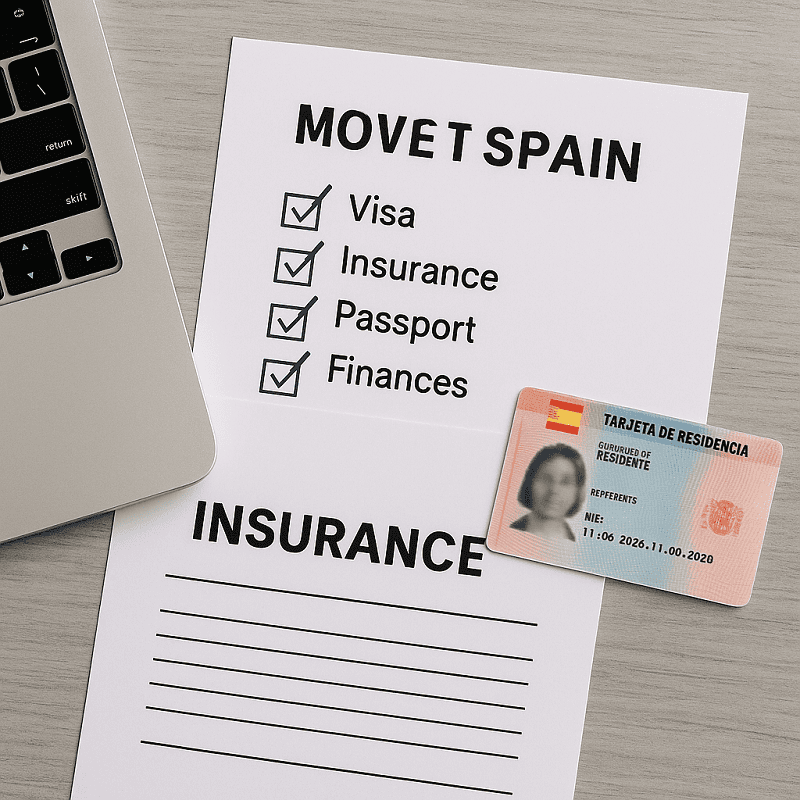
1️⃣0️⃣ Final reminders checklist
✅ Check whether you need a visa or permit
✅ Gather the health cover documents your route requires
✅ Record your NIE or request it if needed
✅ Register your usual address
✅ Check if you need a TIE and note the deadline
✅ Set up banking if it helps with bills
✅ Keep your housing documents
✅ Store a copy of your paperwork
Keep the checklist handy as you settle in.
👉 Explore health insurance plans → See plan details

TEFL Madrid
TEFL Madrid Academy is a prominent institution located in Madrid, Spain, offering accredited TEFL (Teaching English as a Foreign Language) courses designed to prepare students for a career in teaching English. The academy is known for its comprehensive training programs that blend theoretical knowledge with practical teaching experience, ensuring graduates are well-equipped to handle real classroom scenarios.